Notice/News
Notice/News
The external news articles in this bulletin have been collected and published solely for the purpose of providing information and may differ from our official position. We make no guarantee of the accuracy, timeliness, or completeness of the content of the article and are not liable for any direct or indirect damage that may occur.
Notice
[Notice] Update on CTH-401 Development Plans of our Licensing Partner, Cartherics
주식회사 툴젠
|2026.11.03
Dear Shareholders,
We would like to provide an update on the development status of CTH-401, a key pipeline candidate of Cartherics Pty Ltd (“Cartherics”), a private Australian cell therapy development company that has licensed ToolGen’s foundational CRISPR-Cas9 patents and Styx-T (enhanced-function cell therapy platform) technology.
1. Overview of Styx-T
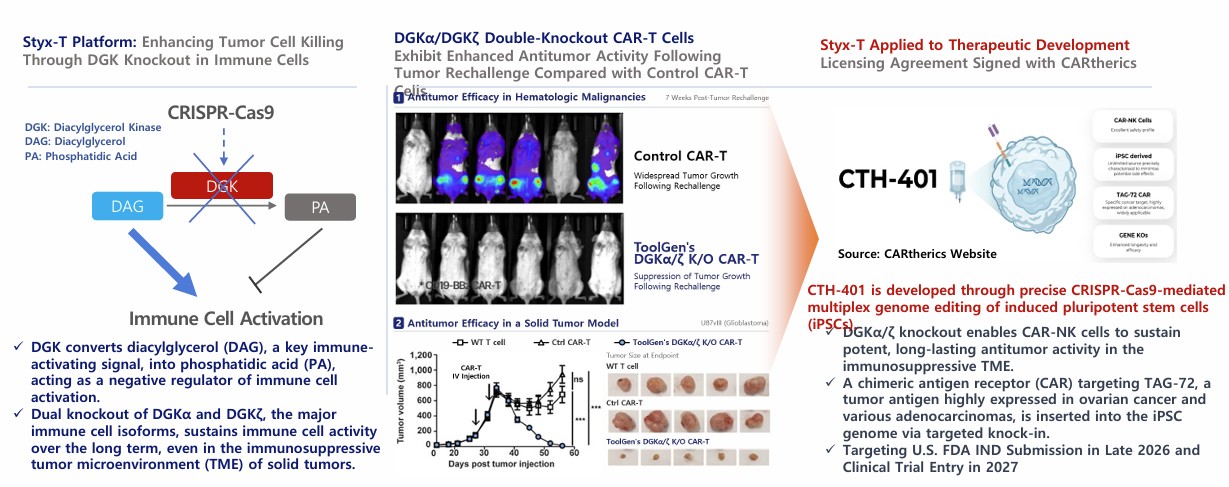
Styx-T is ToolGen’s cell therapy platform designed to enhance the anti-tumor function of immune cells by knocking out DGK¹⁾ genes using gene editing. In in-vitro studies, immune cells with DGK gene knockouts demonstrated enhanced cytotoxicity against cancer cells and increased cytokine secretion. These cells also showed resistance to certain immunosuppressive signals from cancer cells, and improved therapeutic efficacy was observed in tumor-bearing animal models.
Building on clinical success in hematologic malignancies, cell therapy development is now expanding into solid tumors. Overcoming immunosuppression in the tumor microenvironment has emerged as a key technical challenge. ToolGen expects Styx-T to help address these limitations and contribute to expanding the therapeutic applications of next-generation cell therapies. ToolGen is pursuing commercialization collaborations, including licensing collaborations, with cell therapy developers in Korea and abroad.
¹⁾ DGK (Diacylglycerol Kinase): A lipid kinase that suppresses T-cell activation. Simultaneous knockout of DGKα and DGKζ in T cells using CRISPR-Cas9 gene editing significantly enhanced immunotherapeutic efficacy.
2. Overview of CTH-401
CTH-401 is an allogeneic CAR-NK cell therapy candidate being developed by Cartherics. It is based on NK cells differentiated from umbilical cord blood-derived induced pluripotent stem cells (iPSCs). CTH-401 targets TAG-72²⁾, a tumor antigen highly expressed in ovarian cancer and various other solid tumors. It incorporates ToolGen’s Styx-T DGK gene knockout technology and is designed to sustain anti-tumor activity within the tumor microenvironment.
Under the license agreement signed with Cartherics in 2021, ToolGen holds the right to receive milestone payments at various stages of CTH-401's clinical development and royalties following commercialization.
²⁾ TAG-72 (Tumor-Associated Glycoprotein 72): A large mucin-type glycoprotein overexpressed in various adenocarcinomas, including ovarian, colorectal, gastric, and pancreatic cancers. It is involved in cancer metastasis and immune evasion and is used as a serum marker (CA 72-4) and as a target for CAR-T cell therapies.
3. CTH-401 Development Status
Cartherics is initially developing CTH-401 as a treatment for relapsed or refractory ovarian cancer. Subject to initial clinical results, the company plans to expand its indications to other TAG-72-positive solid tumors and, potentially, to earlier-stage ovarian cancer. Cartherics is currently manufacturing clinical trial materials at its own clinical manufacturing facility in Victoria, Australia.
Its top priority is to evaluate the safety and anti-tumor activity of its iPSC-NK platform in a first-in-human clinical trial. Cartherics aims to submit an Investigational New Drug (IND) application to the U.S. Food and Drug Administration (FDA) in late 2026 and dose the first patient in early 2027.
As both a shareholder and licensing partner of Cartherics, ToolGen will closely monitor the development of CTH-401. We will promptly inform our shareholders of any significant developments as they arise.
We appreciate your continued interest and support.
Thank you.
※ Reference materials